
SOURCES LISTED · UPDATED 2026-09-30
What does concrete driveway replacement involve in Houston?
Short answer: replacing a concrete driveway in Houston takes about three working days on site, then roughly a week of waiting. Tear-out and haul-off usually fill day one. Grading, base, forms, and steel fill day two. The pour itself is one morning. After that the new slab needs about seven days before a car should touch it, so plan on parking at the curb for a week and change.
That’s the schedule when everything cooperates. Houston weather doesn’t always cooperate, and neither does whatever’s buried next to your old slab. More on both below.
First, make sure replacement is the right call
Not every rough driveway needs to come out. If yours is cracked but flat, draining fine, and holding your cars without moving, you may be better off leaving the money in your pocket a while longer. We wrote a separate guide on repair versus replacement that walks the decision honestly, including when the answer is “do nothing yet.” This article assumes you’ve crossed that bridge: the slab is failing, and it’s coming out.
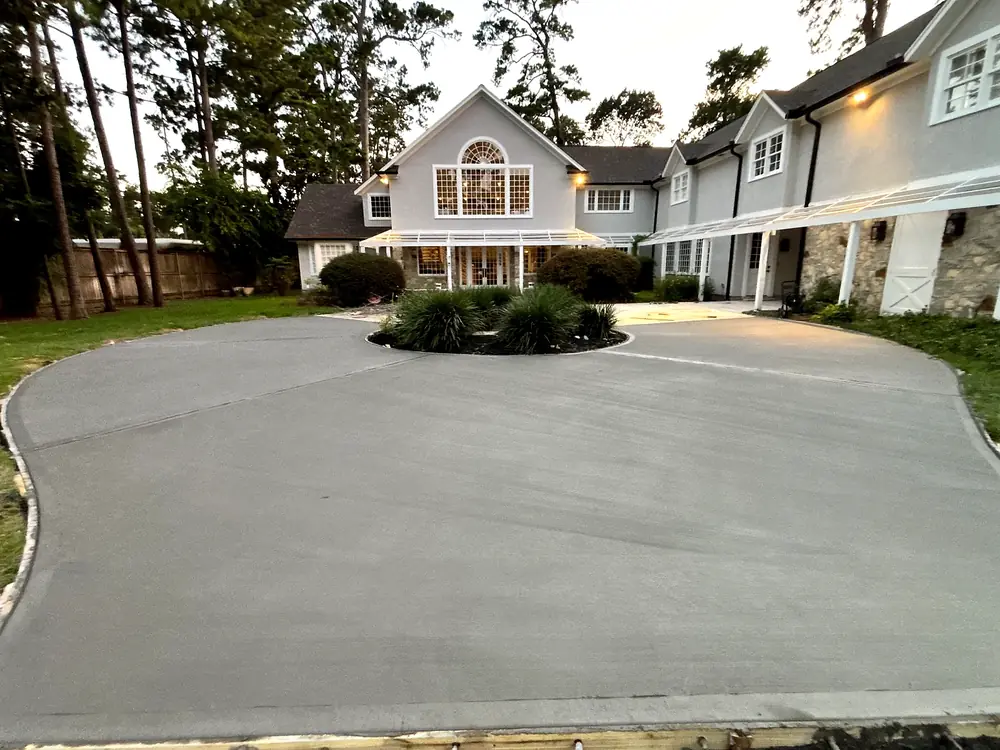
Day one: the tear-out
A driveway replacement starts loud. A breaker or a skid steer with a hammer attachment busts the old slab into pieces, the pieces get loaded into a dump trailer, and everything hauls off to a recycler or disposal site. Old concrete is heavy. A typical two-car driveway, somewhere in the 400 to 600 square foot range, produces several truckloads of rubble, and disposal fees are part of why replacement costs more than pouring the same footprint on an empty lot.
Tear-out day is also discovery day. Once the old slab is out, you can see exactly why it failed. Around here it’s usually no steel and no compacted base, just concrete poured straight on graded clay, often thinner than it should’ve been. That matters. The tear-out is your one chance to fix the actual cause instead of repeating it, because the new slab inherits whatever ground the old one died on. Houston sits on the black gumbo clay that swells when it rains and shrinks hard in August, and a slab with nothing under it takes that movement straight, year after year. It’s the whole story behind why new concrete cracks.
One thing worth flagging before the machines show up: sprinkler lines. Irrigation pipe loves to run right along the edge of an old driveway, and tear-out finds it the hard way. A good crew walks the yard with you first and asks where the lines run. If you don’t know, say so, and we’ll work carefully near the edges rather than guess.
Day two: rebuilding what the old driveway never had
Day two is the part nobody brags about, because most of the work disappears underground. That’s also why it matters.
- We shape the exposed soil so water leaves the house instead of creeping back toward the garage.
- Then base goes down and gets compacted into a firm layer, so the clay can move without shoving every inch of that movement straight into the slab.
- Forms set the edges, curves, and flares.
- Steel goes on chairs, lifted into the middle of the concrete where it can hold cracks tight instead of lying useless in the dirt.
If your address requires a permit, the inspection usually lands here, after the forms and steel are in and before any concrete arrives. Whether you need one depends on the address, not the county, and the patchwork is genuinely confusing. Our permit guide sorts Houston, the enclave cities, and unincorporated Harris County. The short version is that we check what your specific address requires before we bid, so the paperwork question is settled before day one.
Pour day: one morning, moving fast
In a Houston summer the pour starts early, because heat makes concrete set faster and the crew needs to place, screed, and finish the whole driveway before the mix stops cooperating. Trucks arrive, the concrete goes down, and for a couple of hours the crew works it more or less continuously: striking it flat, floating it, cutting in the edges, dragging the broom finish that gives a driveway its grip. Control joints get cut the same day, straight lines that tell the slab where it’s allowed to crack.
By evening it looks done. It isn’t, and that’s the next part.
Then a week of doing nothing, on purpose
New concrete hardens by a slow chemical reaction, not by drying, and it builds strength for weeks.
The usual rules of thumb in the trade run like this:
Common rules of thumb for new concrete
- Foot traffic: after 24 to 48 hours
- Regular cars: after about seven days
- Moving trucks and other heavy stuff: after 28 days
We wrote up the full cure timeline and what rushing it costs.
Here’s the honest downside of a replacement, and it’s real: you lose your driveway for about a week. Cars live on the street and the garage is out of reach, which also means the trash bins need a new home on pickup day. It’s a hassle. We’d rather say that plainly than have you find out at walkthrough. Weather can stretch it too. If rain moves in on pour day, the pour moves, because pushing concrete through a storm to protect a schedule is how you end up with a ruined finish.
Can you replace just part of it?
Sometimes, and it’s worth asking. Concrete driveways are built in panels separated by joints, and if one panel failed while the rest sit flat and solid, that panel can come out and be repoured on a proper base. The catch, though, comes in two parts. New concrete will not match 30-year-old concrete, and the color difference softens with time but never disappears. And if most of the panels are cracking, patching them one at a time means paying mobilization over and over to chase a failure that’s system-wide. When more than a third or so of the driveway is going, full replacement usually wins the math.
Panel or whole driveway
- One failed panel, the rest flat and solid: that panel can come out and be repoured on a proper base
- More than a third or so of the driveway going: full replacement usually wins
What it costs
Replacement costs more than a fresh pour on bare dirt because first you have to pay to make the old driveway disappear. Breaking it, loading it, hauling it, and dumping it all take labor, equipment, and fees before a yard of new concrete ever shows up.
Our driveway cost guide keeps the current Houston market ranges in one place, and our pricing page shows the line items behind a quote. If one replacement bid is far below the others, look hard at the invisible parts, the base and the steel. They’re easy to skip on paper and impossible to inspect once the driveway looks finished.
Getting a straight read on yours
Send us a few photos of the driveway, tell us roughly how big it is and what’s bugging you about it, and we’ll give you an honest read, including “this can wait” if that’s the truth. Start here and you’ll hear back within 24 hours, with a written quote in your hands within the week.
Sources
- Houston Permitting Center: Residential Driveway, Sidewalk, or Curb & Gutter Permit (HPWOCE1011) (houstonpermittingcenter.org)
- HomeGuide: How Much Does a Concrete Driveway Cost (2026) (homeguide.com)
- USDA Soil Survey of Harris County, Texas (1976) (archive.org)
- NRMCA Concrete in Practice 6: Joints in Concrete Slabs on Grade (nrmca.org)
- FHWA: Guide for Curing Portland Cement Concrete Pavements, Chapter 2 (fhwa.dot.gov)
- NRMCA Concrete in Practice 12: Hot Weather Concreting (nrmca.org)
Page updated 2026-09-30. For your own job, whoever has jurisdiction sets the rules, and your written quote sets the price.