
SOURCES LISTED · UPDATED 2026-09-30
Why does new concrete crack, and when should you worry?
Short answer: all concrete cracks, including concrete poured perfectly. As it cures, concrete shrinks a small amount, roughly a sixteenth of an inch for every ten feet of slab. That movement has to go somewhere. The whole game is deciding where the cracks happen, which is what those straight sawn lines in a good driveway are for.
So the useful question is not “will it crack” but “which cracks are normal and which mean something went wrong underneath.”
The cracks that are supposed to happen
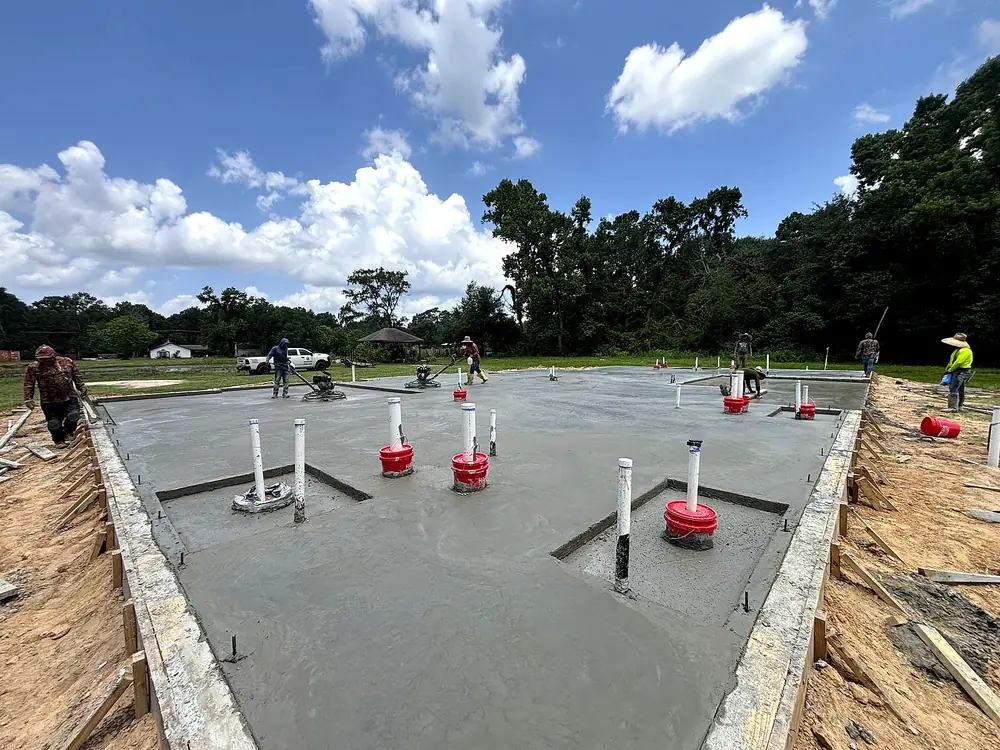
Look at any well-built driveway and you will see straight grooves dividing it into panels. Those are control joints, cut into the slab within hours of the pour. They are planned weak lines, and the shrinkage crack forms at the bottom of the groove where you never see it. When a contractor talks about joint spacing, this is what they mean: panels sized so the concrete’s natural movement lands in the joints instead of wandering across the surface.
Hairline surface cracks between joints can still show up, especially in a Houston summer, and a tight hairline that never grows is cosmetic. Concrete is rock, not rubber. A hairline is the material being honest with you.
The cracks that mean trouble
Different story if you see any of these. Cracks that are wide enough to catch a house key. Cracks where one side sits higher than the other. Cracks that keep growing month after month, or that run in stair steps through multiple panels. Those patterns almost always point below the slab: soil that was never compacted, base material that washed out, or a tree root doing slow demolition. The concrete is just reporting the problem, the way a bent picture frame reports a crooked wall.
That distinction matters in Houston more than most places, because our expansive clay moves with every wet season. A slab poured on prepared, compacted base rides that movement as one piece. A slab poured on whatever was there after grading gets worked apart, one season at a time.
What prevention looks like before the truck ever arrives
By the time concrete is on the ground, the crack story is mostly already written. It gets written during the boring parts: compacting the base in lifts, placing steel on chairs so it sits in the middle of the slab instead of the bottom, timing the saw cuts before the slab decides where to crack on its own, and curing the surface instead of letting an August afternoon flash-dry it.
That is why our published spec spends most of its words on what happens under and before the concrete. Joint layout and cure guidance come with the job in writing, and every phase gets photographed before the next one hides it. If a crack ever worries you, on our work or anyone else’s, send us a photo of it. Reading cracks is free, and we would rather look at ten harmless hairlines than have you lose sleep over one.
Sources
- Euclid Chemical (admixture maker): Concrete Cracks (euclidchemical.com)
- NRMCA Concrete in Practice 6: Joints in Concrete Slabs on Grade (nrmca.org)
- NRMCA Concrete in Practice 4: Cracking Concrete Surfaces (nrmca.org)
- NRMCA Concrete in Practice 12: Hot Weather Concreting (nrmca.org)
- USDA Soil Survey of Harris County, Texas (1976) (archive.org)
Page updated 2026-09-30. For your own job, whoever has jurisdiction sets the rules, and your written quote sets the price.