
SOURCES LISTED · UPDATED 2026-09-30
When can you drive on new concrete?
Short answer: foot traffic after 24 to 48 hours, regular cars after about seven days, and heavy vehicles, the moving truck, the RV, the concrete truck for your neighbor’s project, after 28 days. Those are the common rules of thumb in the trade, and your specific job gets its own written version at walkthrough.
The annoying part is that new concrete looks ready long before it is. By day two it is hard, gray, and walkable, and the driveway sitting there empty feels like wasted real estate. Here is what is actually happening inside it, and why the calendar matters more than the look.
Curing is a chemical process, not drying
Concrete does not harden by drying out. It hardens because cement and water are locked in a slow chemical reaction that knits crystals through the mix, and that reaction runs for weeks. At seven days, standard curing guidance treats roughly 70 percent of design strength as the point where curing can stop, which is why a week is the usual mark for cars. The 28-day mark is the industry’s standard finish line because that is where the mix reaches the strength it was engineered for.
Drive a car onto it at day two and the surface may survive, but you are loading a material that is still assembling itself. The damage that causes rarely announces itself immediately. It shows up later as edge chips and hairline cracks that started as invisible stress on a young slab.
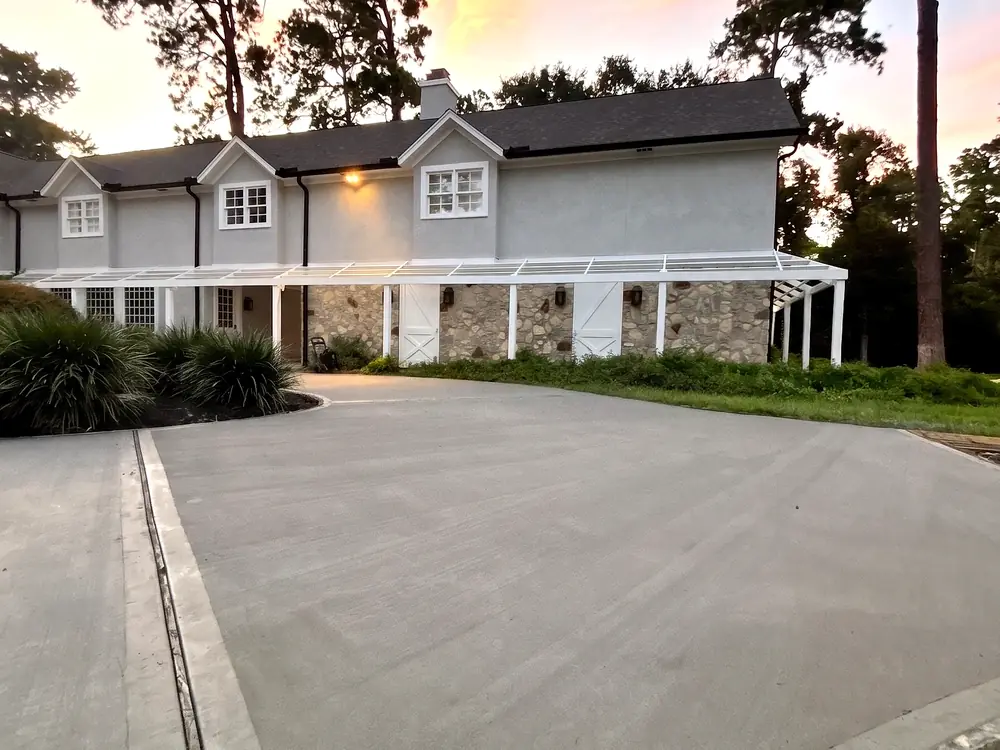
Houston heat makes this trickier, not easier
Hot weather makes concrete set faster, which tempts everyone to trust it sooner. But fast setting is not the same as strong curing. Heat pulls moisture out of the slab before the chemistry can use it, which is why summer pours here get cure measures, and why the surface being rock hard on a 100 degree afternoon proves less than it seems to.
The order of return, in practice
- People and pets first, a day or two in.
- Then patio furniture and the basketball hoop.
- Cars roll on around day seven, toward the middle of the slab rather than riding the fresh edges for the first stretch.
- Heavy anything waits for the month mark.
The edges stay the tender spot the whole time: a wheel near the edge has concrete on only one side of it, so that’s where a young slab breaks first.
One more habit worth keeping after day 28: that new slab will shed water toward wherever it was graded to drain. Watch one good rainstorm and make sure downspouts and sprinklers are not pooling against an edge, because water under a slab undoes patient curing faster than any car ever will.
Every job we pour leaves with these windows in writing, matched to the mix and the season, as part of the walkthrough covered in our published spec. If you are staring at a fresh gray slab right now wondering about your specific situation, send us a photo and the pour date. Reading it costs nothing, and you will hear back within 24 hours.
Sources
- FHWA: Guide for Curing Portland Cement Concrete Pavements, Chapter 2 (fhwa.dot.gov)
- American Concrete Institute FAQ: 7-day and 28-day strength test results (concrete.org)
- American Cement Association (formerly PCA): Cement and Concrete FAQ (cement.org)
- NRMCA Concrete in Practice 11: Curing In-Place Concrete (nrmca.org)
- NRMCA Concrete in Practice 12: Hot Weather Concreting (nrmca.org)
Page updated 2026-09-30. For your own job, whoever has jurisdiction sets the rules, and your written quote sets the price.