
SOURCES LISTED · UPDATED 2026-09-30
Do you need a City of Houston permit to replace a driveway or sidewalk?
Short answer: usually, yes. Inside Houston city limits, a new driveway, a replaced one, a longer one, and most sidewalk or curb work in front of the house all run through one permit, the Residential Driveway, Sidewalk, or Curb & Gutter Permit. The permitting center files it under the code HPWOCE1011, which is handy to have if you ever call them.
Kingwood counts. It’s been part of Houston since 1996, so a Kingwood driveway goes through the same permit as one in the Heights.
What the permit covers
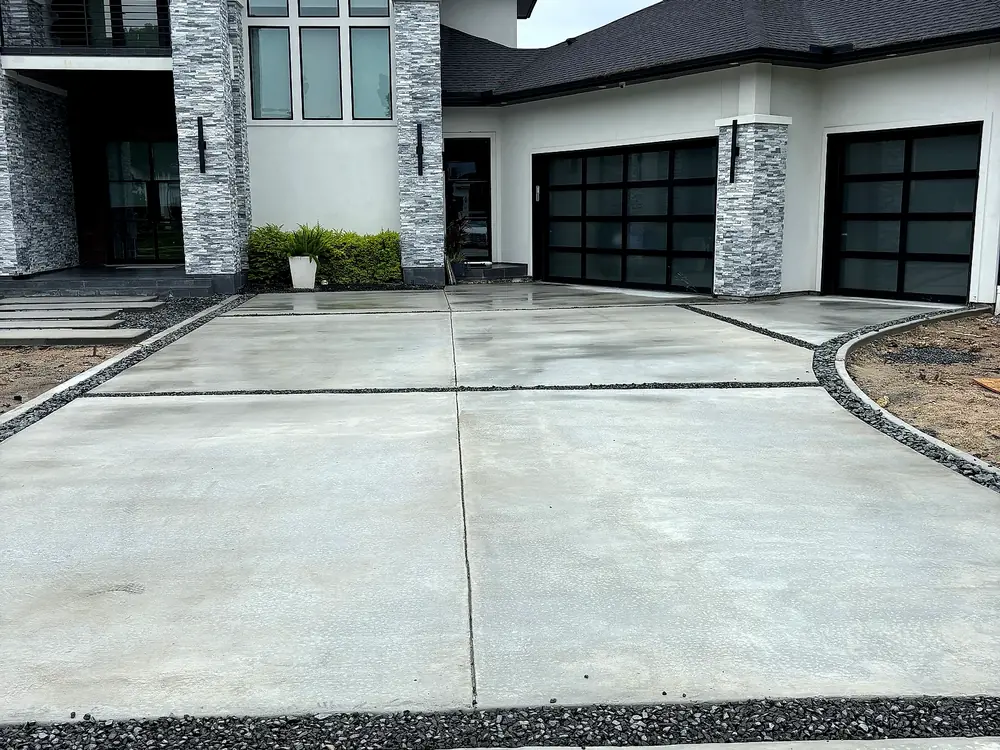
The city’s own description is short. It covers building a new driveway or sidewalk, removing and replacing an existing driveway, sidewalk, or curb and gutter, and extending a driveway. That last part catches people off guard. Widening the slab for a third car is an extension.
Concrete behind the house is a different question. Patios and other paving on your own lot fall under a separate paving permit for private property, and we wrote up the patio side on its own because that answer is less clear-cut.
What goes in the application
The Houston Permitting Center lists what it wants: an application with a project number, two dimensioned site plans, a copy of your survey, and form CE1023, the sidewalk and driveway permit application. Plan review is required. The posted fee is “minimum $103.00 and varies higher,” the posted processing time is one business day, and the permit stays valid for a year. Change the design after approval and it goes back through revision.
Look closely at form CE1023 and you’ll find a blank for a “Sidewalk, Driveway, Curb and Gutter Bond Number.” It surprises a lot of homeowners.
The builder’s bond, explained plainly
Houston’s building code says the city won’t issue a permit to build, rebuild, repair, or regrade a driveway approach, sidewalk, culvert pipe, curb, or gutter unless the applicant shows a bond under Section 40-95 of the City Code. The city’s bond form sets the amount at $2,000, payable to the City of Houston. The holder promises to follow the city’s ordinances, build to the line and grade the city engineer sets, and answer for damage caused by negligent or defective work.
Two thousand dollars isn’t much, and it won’t pay to fix your driveway. Think of it as the city keeping a name on file for whoever cuts into the public right-of-way.
The bond at a glance
$2,000, payable to the City of Houston, under Section 40-95 of the City Code. Needed to permit work on a driveway approach, sidewalk, culvert, curb, or gutter. The one homeowner exception: culvert pipe, or an approach where no curb cut is required.
There’s one narrow exception. The same code section says a homeowner will be issued a permit without the bond to install culvert pipe, or to build a driveway approach where no curb cut is required. Streets with open ditches and culverts are where that tends to come up. On a curb and gutter street, plan on a bonded applicant pulling the permit. If the curb cut is already there, ask the permitting center how they read that for your address.
If you’re hiring the work out, ask who is pulling the permit and for their bond number before you sign anything.
Two inspections, and the pour waits on the first
This is where the schedule gets set. The city’s sequence runs like this:
Inspection order
- Permit issued and paid, bond current, traffic-approved stamped plans in hand
- Culvert in, driveway and sidewalk fully formed
- Inspection before any concrete is placed
- The pour
- Inspection after placement, for final approval
Inspections are booked for the next business day. Same-day isn’t offered. Build off the stamped site plan, too, because if the forms don’t match it you reschedule, and failing more than once adds a re-inspection fee plus an administrative fee.
In practice that means forms go up, the inspection lands a business day later, and the ready-mix gets ordered once it passes. A crew that books the truck before the inspection is betting on the calendar.
The sidewalk out front
What triggers Houston’s sidewalk review
A new sidewalk, or repairing or replacing a stretch longer than 20 feet (Chapter 40, per the Planning Department’s March 2023 FAQ).
Since October 2020, the Planning and Development Department checks sidewalk width and location along public streets, and the Office of the City Engineer reviews the engineering. So a full-width replacement across your frontage may get measured against today’s standards instead of simply matching the old walk.
A permit doesn’t override your deed restrictions
The application itself carries a warning worth knowing: a permit doesn’t authorize work that breaks your deed restrictions, and building in violation of them makes the permit void. If your street has an HOA or a civic association with architectural review, get that sign-off first. Our HOA approval guide walks through how that review works.
How we help on a Houston driveway
We don’t pull Houston’s driveway permit ourselves. Before we bid, we tell you who pulls it for your address. Our part is the dimensioned site plan the city asks for, drawn to our driveway method, and a pour date that waits on the first inspection instead of guessing at it.
Permit rules change, and the Houston Permitting Center has the final word for your address. We last checked the city’s pages and code sections above in September 2026. This is general information, not legal advice.
Sources
- Houston Permitting Center: Residential Driveway, Sidewalk, or Curb & Gutter Permit (HPWOCE1011) (houstonpermittingcenter.org)
- Houston Permitting Center: Sidewalk-Driveway permit application, form CE1023 (houstonpermittingcenter.org)
- Houston Permitting Center: Sidewalk, Driveway, Curb and Gutter Builders Bond form (houstonpermittingcenter.org)
- Houston Amendments to the 2021 International Building Code, Section 3116.4.10 (bonded contractor) (houstonpermittingcenter.org)
- City of Houston Planning: Sidewalk FAQ (March 2023), Chapter 40 (houstontx.gov)
- City of Houston: Super Neighborhood 43, Kingwood Area (houstontx.gov)
Page updated 2026-09-30. For your own job, whoever has jurisdiction sets the rules, and your written quote sets the price.